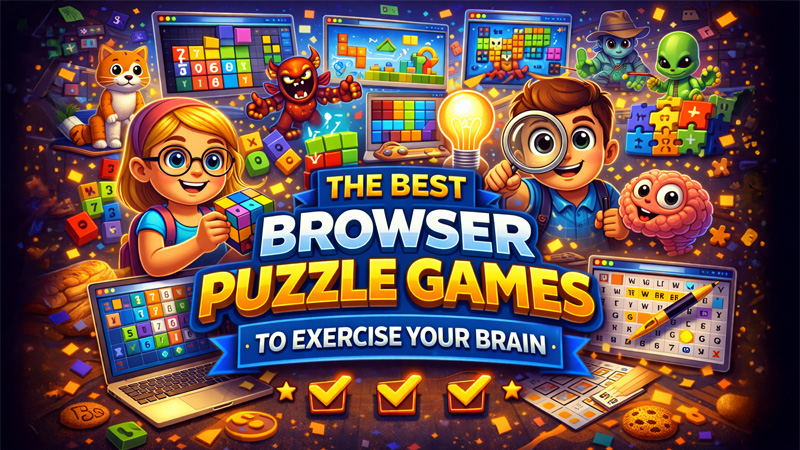
Puzzle games are the most cerebral corner of browser gaming. They do not require fast reflexes, competitive instincts, or hours of grinding. They require only one thing: to think clearly about a problem until you find the solution.
The best puzzle games produce a specific feeling when you solve them — a click of understanding, a rush of satisfaction, and the immediate desire to try the next one. Here are the browser puzzle games most likely to give you that feeling.
The Impossible Quiz
A trick question game that subverts every expectation — nothing can be taken at face value.
The Impossible Quiz is the platonic ideal of a trick question game. Every question subverts your expectations in a different way. Some questions require clicking on a specific word in the question rather than one of the answers. Some require not clicking at all. Some require information from several questions ago. Some are just wrong on purpose.
The experience of playing The Impossible Quiz is a sustained exercise in questioning your assumptions. The game teaches you, over hundreds of failures, that nothing can be taken at face value. This is actually a useful cognitive exercise.
The sequel, The Impossible Quiz 2, escalates the cruelty while maintaining the inventiveness.
Bloxorz
Guide a rectangular block across a suspended grid without falling — spatial planning at its finest.
Guide a rectangular block across a suspended platform grid by tilting it in four directions without falling off the edge. The block's three-dimensional shape relative to the two-dimensional grid creates genuinely challenging spatial puzzles.
The key insight in Bloxorz is that you need to think several moves ahead. The block's orientation after each move determines what moves are possible next. Planning two moves ahead is basic. Planning four or five moves ahead is how you solve the harder levels without getting stuck.
2048
Slide numbered tiles across a 4x4 grid and combine them to reach the legendary 2048 tile.
Slide numbered tiles across a 4x4 grid, combining matching numbers to create larger ones. Your goal is to create the 2048 tile. Simple rules, combinatorially complex strategy.
The game feels approachable but is genuinely hard to master. Most casual players never reach 2048 on their first few attempts. The key is understanding that you need to keep your largest tile in a corner and build outward from it — a strategy that is not obvious without deliberate thought.
Little Alchemy 2
Combine elements to discover hundreds of materials and concepts — guided by curiosity and lateral thinking.
Combine elements to discover new materials and concepts in Little Alchemy 2. Start with earth, fire, water, and air. Combine earth and water to make mud. Combine fire and air to make energy. Keep combining to discover life, humans, tools, civilisations, and hundreds of other concepts.
Little Alchemy 2 rewards lateral thinking. Some combinations are logical — water plus fire makes steam. Others require more creative leaps. The satisfaction of discovering an unexpected combination makes this one of the most purely enjoyable puzzle games available.
Draw the Bridge
Draw bridges and structures with your mouse to help vehicles cross gaps in this physics-based puzzle game. The freeform drawing mechanic means there is no single correct solution — any structure that supports the vehicle's weight and gets it across is a valid answer.
Draw the Bridge is creatively open in a way that most puzzle games are not. Engineers in particular tend to find it deeply satisfying.
Hexa Puzzle
Place hexagonal pieces onto a grid, completing rows and columns to clear them. Similar to Tetris in concept but meaningfully different in execution — the six-sided pieces create different fitting challenges and require different spatial intuition.
Hexa Puzzle scales its difficulty gracefully. Early levels are almost meditative. Later levels require careful planning about piece placement sequencing.
Nuts and Bolts Puzzle
Remove screws and bolts from mechanical assemblies in the correct order to disassemble each contraption. The puzzle comes from figuring out which fasteners are blocking others from being removed.
This game rewards methodical, systematic thinking. Trying to remove a bolt that is pinned by another will fail. You need to identify the order of operations before you begin, like planning the solution to a multi-step maths problem.
The Wordle Variants
The original Wordle — guess a five-letter word in six attempts with colour feedback on correct letters — spawned dozens of browser variants. Worldle uses countries. Heardle uses song intros. Quordle runs four Wordles simultaneously.
These games are genuinely educational alongside being entertaining. Regular Wordle play measurably improves vocabulary and pattern recognition. The daily format — one puzzle per day — prevents them from consuming too much time.
Portal
Valve's physics-based puzzle game where portals allow objects and yourself to move through connected spaces is now playable in browser. Place portals on walls, floors, and ceilings to redirect your movement and solve spatial challenges that become increasingly mind-bending.
Portal is not a simple browser puzzle game — it is a full-scale critically acclaimed puzzle masterpiece. If you have not played it, the browser version is the best free introduction available.
How to Get Better at Puzzle Games
The skill that transfers across all puzzle games is the ability to hold the current state of a problem clearly in your mind while exploring potential moves forward.
In chess terms, this is called "visualisation." In everyday terms, it is just careful thinking. Rushing rarely helps in puzzle games. The solution is almost always visible if you slow down and look at the complete problem rather than the nearest obstacle.
When you are stuck, the most useful technique is to start from the desired endpoint and work backwards. What would the board have to look like one step before the solution? Two steps before? Working backwards often reveals a path that forward thinking misses.